
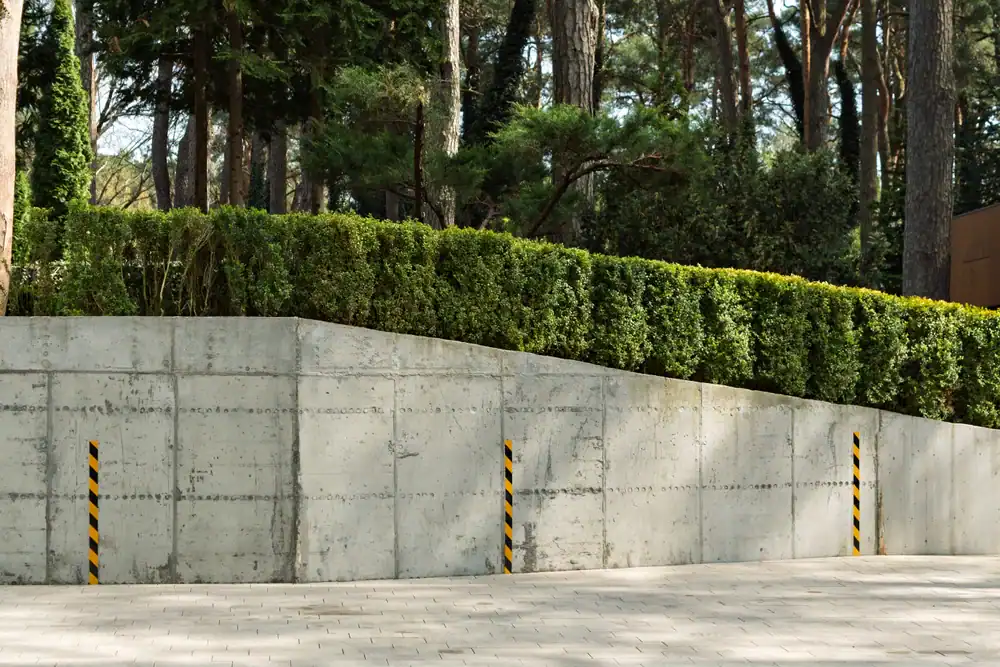

A retaining wall isn’t just stacked blocks. It’s engineered support that stops soil from washing into your driveway, protects your foundation, and turns a sloped mess into usable yard space.
When it’s done right, you get clean drainage behind the wall, no bowing or cracking after the first freeze, and a structure that doesn’t need a rebuild in five years. That means your walkways stay level, your landscaping stays put, and you’re not dealing with erosion every time it rains.
You also get something that looks intentional. A well-built concrete retaining wall adds definition to your property. It creates boundaries, frames garden beds, and gives your yard the kind of structure that makes everything else look better. Not decorative—functional. But it doesn’t hurt that it cleans up the whole look.
We’ve been handling residential projects across Bloomfield Township and the surrounding area for years. We’re not new to how New Jersey soil shifts, how freeze-thaw cycles crack poorly built walls, or what it takes to get a permit approved in Essex County.
We don’t subcontract the hard parts. Our crew handles the excavation, the base prep, the block placement, and the backfill. You get the same people from start to finish, and they know what a retaining wall in Ampere North actually needs to survive.
We also don’t disappear after the install. If something’s off, we’re local enough to come back and make it right.

First, we assess your slope, soil type, and drainage situation. Not every yard in Ampere North drains the same way, and not every retaining wall needs the same foundation depth. We measure, check grades, and figure out if you need a permit before we touch a shovel.
Then we excavate and prep the base. This is where most DIY jobs and cheap contractors fail. We dig below the frost line, compact the base material in layers, and make sure it’s level. If the base shifts, the whole wall shifts. We don’t skip this.
Next, we install the retaining wall blocks with proper drainage behind them. That means gravel backfill, perforated pipe if needed, and filter fabric to keep soil from clogging everything up. Water has to go somewhere, and if it builds up behind your wall, you’re looking at cracks or collapse.
Finally, we backfill, compact, and clean up. You’re left with a block wall retaining wall that’s built to code, drains correctly, and doesn’t need a redo in three years.

Ready to get started?
You’re getting concrete retaining wall blocks that are rated for structural use, not the lightweight stuff from a big box store. These blocks interlock, they’re designed to handle load, and they work with New Jersey’s soil conditions and weather.
You’re also getting proper drainage. We install gravel backfill and drainage pipe so water doesn’t build up behind the wall. Hydrostatic pressure is the number one reason retaining walls fail, and it’s completely preventable if the install is done right.
In Ampere North, where properties are close together and lot lines matter, you’re also getting a wall that’s built to local code. Walls over four feet usually need a permit here. Walls over six feet need engineered plans. We handle that process so you’re not dealing with the township on your own or risking a violation that kills a future sale.
And if your existing wall is failing—leaning, cracking, or pulling away from the soil—we’ll assess whether it needs full replacement or if repairing retaining wall sections will hold. Not every problem needs a teardown, but we’ll tell you straight if it does.

It depends on height, length, soil conditions, and whether you need a permit or engineered design. A basic wall under four feet might run less than a taller, more complex install that requires drainage work and structural engineering.
In northern New Jersey, expect to pay more than you would in other states. Materials cost more here, labor costs more, and if your property has access issues or needs significant excavation, that adds to it. But you’re also building something that has to survive freeze-thaw cycles, heavy rain, and soil that doesn’t always cooperate.
We give free estimates. We’ll come out, look at your slope, talk through what you’re trying to do, and give you a number that includes everything—no surprises halfway through the job.
If your wall is over four feet tall, yes. If it’s over six feet, you’ll also need an engineered design before the township will approve it. These aren’t suggestions—they’re code requirements, and if you skip them, you could be forced to tear the wall down or face fines.
Even if your wall is under four feet, it’s worth checking with the township. Some municipalities have additional rules if the wall is near a property line, a right-of-way, or a drainage easement. We’ve dealt with this process enough times to know what Bloomfield Township typically requires.
We can handle the permit application for you, or at minimum, make sure the wall is built to pass inspection. Don’t assume your installer is doing this unless they specifically say so.
Concrete retaining wall blocks are the most common choice because they’re durable, affordable, and handle freeze-thaw cycles better than most other options. They also don’t rot, rust, or need ongoing maintenance the way timber or metal can.
Natural stone looks great and lasts forever, but it’s expensive and requires more skilled labor to install correctly. If you want that look and have the budget, it’s a solid choice. Just know it’s going to cost significantly more than concrete block.
Timber is cheaper upfront but doesn’t last as long, especially in New Jersey’s wet climate. Treated wood will eventually rot, and you’ll be looking at replacement or repair in 10 to 15 years. For most residential projects in Ampere North, concrete block gives you the best balance of cost, durability, and performance.
Most retaining walls fail because of poor drainage. When water builds up behind the wall with nowhere to go, it creates pressure that pushes the wall forward. That’s how you get bowing, cracking, and eventual collapse.
The fix is simple: install proper drainage during construction. That means gravel backfill, a perforated drain pipe at the base, and filter fabric to keep soil from clogging the system. If your installer isn’t talking about drainage, they’re setting you up for problems.
The other common failure point is a weak foundation. If the base isn’t deep enough, compacted enough, or level enough, the wall will shift over time. This is especially true in New Jersey, where freeze-thaw cycles can move soil and heave poorly built walls right out of the ground. A proper base, installed below the frost line, prevents this.
It depends on what’s failing and why. If the wall is leaning slightly but the blocks are intact and the base is still solid, we might be able to reinforce it or improve the drainage to stop further movement. Minor cracks can sometimes be addressed without a full teardown.
But if the wall is leaning more than a few inches, if blocks are cracking or separating, or if the foundation has shifted, you’re usually looking at replacement. Trying to patch a structurally compromised wall is a temporary fix at best, and it often costs more in the long run than just rebuilding it right.
We’ll assess your wall honestly. If it can be repaired, we’ll tell you. If it’s too far gone, we’ll explain why and what a replacement involves. Either way, you’ll know what you’re dealing with before we start any work.
A straightforward wall under four feet might take a few days, depending on length and site conditions. Taller walls, walls that need engineered designs, or projects with difficult access can take longer—sometimes a week or more.
Weather also matters. We can’t pour bases or compact soil in heavy rain or frozen ground, so winter and early spring projects sometimes face delays. But we’ll give you a realistic timeline upfront and keep you updated if anything changes.
Most of the time is spent on excavation and base prep, not the actual block installation. Rushing the foundation to speed things up is how walls fail. We’d rather take the extra day to do it right than have you call us back in two years because the wall is leaning.
Other Services we provide in Ampere North