Summary:
The "Bouncer" of the Backyard: What These Walls Actually Do
At its simplest, a retaining wall is a vertical line in the sand that tells the earth, “You shall not pass.” But behind that stone face is a constant battle against gravity and lateral earth pressure. It’s essentially a structural dam that keeps your backyard from becoming a front-yard over the course of a single rainy season.
In Morris County, where “flat land” is often a myth, these walls are the secret to keeping your driveway from shifting and your pool from becoming a pond. They aren’t just for show; they are vital pieces of engineering that handle the weight of saturated soil—which, fun fact, weighs about as much as a small SUV for every few cubic yards.
Without a solid retaining wall, water follows the path of least resistance, which usually leads directly to your foundation. By managing that flow, these masonry heroes make sure that water goes where it’s supposed to (the street) rather than where it isn’t (your basement).
Preventing the "Jersey Slide": Erosion and Foundation Safety
Erosion is a slow-motion disaster. It starts with a little bit of mulch washing away and ends with your foundation sitting on a hollow void. In the 973 area code, our spring snowmelt can carry away topsoil faster than a shoplifter at a mall, compromising the very ground your home sits on.
A professional retaining wall puts an end to this geological migration. By leveling the land and installing a proper “drainage spine,” we make sure the rain behaves itself. The wall isn’t just a barrier; it’s a redirection system that turns a chaotic hillside into a controlled environment.
However, the real enemy isn’t the dirt—it’s the water trapped behind the dirt. This creates “hydrostatic pressure,” which is basically a fancy way of saying the water is trying to punch a hole through your wall. If your wall doesn’t have a way to “sweat” that water out, it’s only a matter of time before it starts to bow and eventually pop.
From "Mountain Goat Territory" to BBQ Paradise
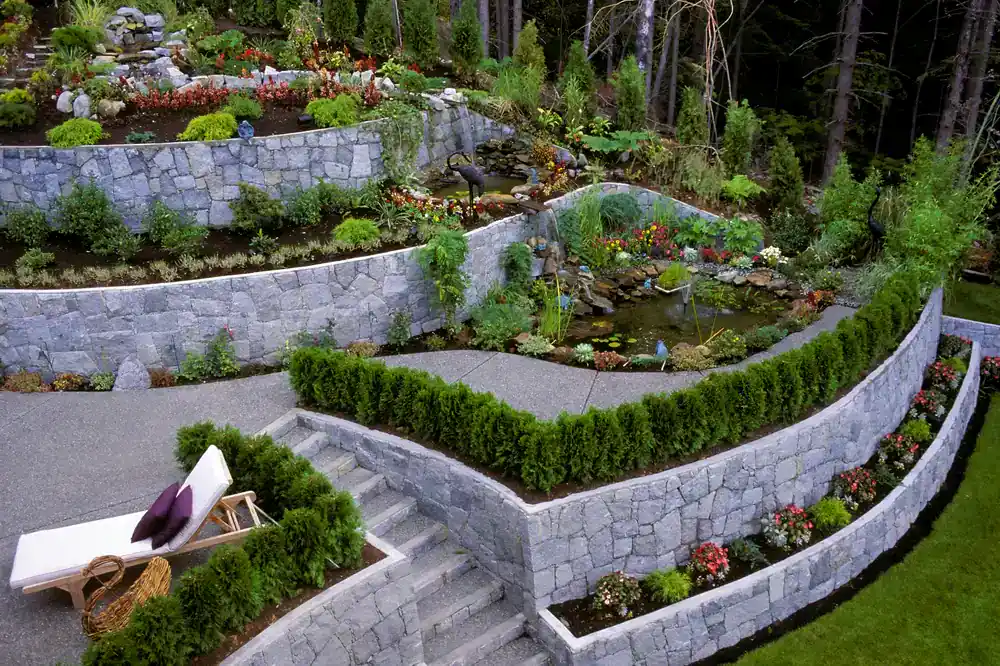
Let’s be honest: a 45-degree backyard is basically useless for anything other than extreme sledding. You can’t put a table there, you can’t kick a ball there, and mowing it feels like a death-defying stunt. Retaining walls take that vertical “dead zone” and turn it into a series of flat, usable terraces.
By tiering your yard, you’re effectively adding square footage to your life. One level becomes the “grill station,” another becomes the “flower sanctuary,” and the top level is where the kids can play without rolling into the neighbor’s yard. It’s like an addition to your house, just without the roof and the plumbing bills.
This isn’t just good for your Saturday afternoon; it’s great for your bank account. Appraisers love to see level, functional yards in Morris and Essex Counties. A tiered landscape suggests the home is well-engineered and ready for entertaining, often returning significantly more than the cost of the stone itself.
The "Wall of Shame": Why Some Structures Fail
We’ve all seen them: the retaining walls that look like they’ve had a few too many drinks, leaning precariously over a sidewalk. Usually, these “Wall of Shame” candidates fail because someone thought they could “DIY” a structural project with some YouTube videos and a weekend at a big-box store.
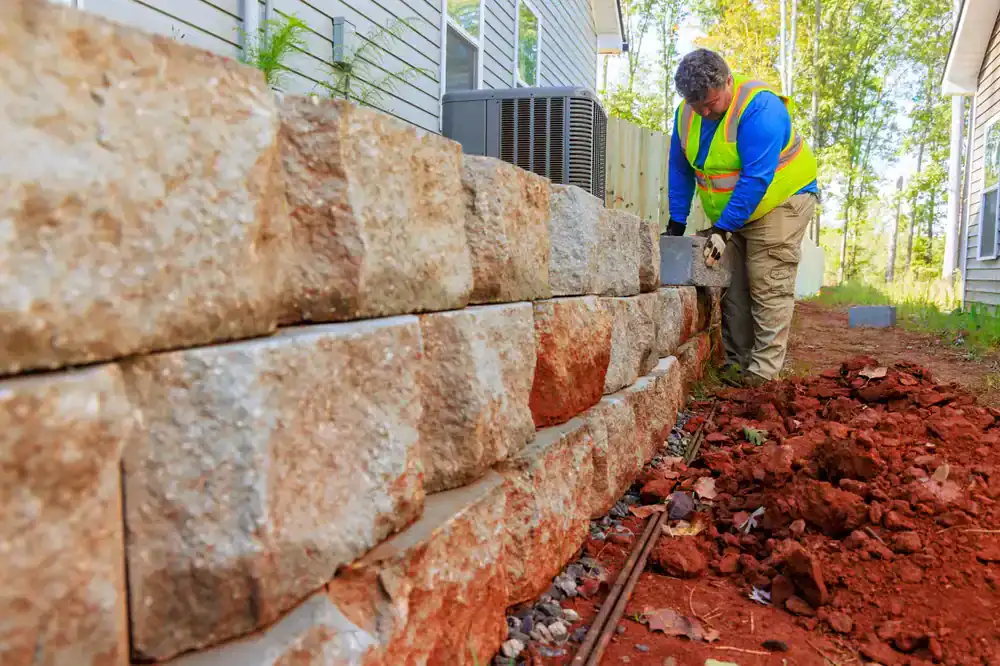
Most failures happen because of “The Big Two”: zero drainage and a shallow foundation. If the wall isn’t buried deep enough in the ground, the freeze-thaw cycle will simply kick it over. If there’s no gravel behind it to let water escape, the sheer weight of the mud will eventually win the fight.
Fixing a leaning wall is usually twice as expensive as building it right the first time because you have to pay for the “un-building” process too. It’s one of those rare cases where being cheap is actually the most expensive thing you can do for your property.
The "Exit Strategy": Drainage Systems That Actually Work
A retaining wall without drainage is just a very heavy, temporary dam. To keep the wall standing for 50 years instead of five, we build in an “exit strategy” for water. This starts with a layer of clean, crushed stone behind the blocks that acts like a massive filter, preventing the soil from clogging up the works.
At the bottom of that stone layer lives the MVP: the perforated drain pipe (often called a French drain). This pipe collects the water that trickles through the gravel and carries it out to a safe discharge point. It’s a 24-hour security system for your masonry, making sure the pressure never gets high enough to cause a “brick-tastrophe.”
In the clay-heavy soils of Northern NJ, we also use “weep holes”—small openings in the face of the wall that let the wall “breathe” out excess moisture. If it’s raining hard in Morristown and you see water trickling out of the weep holes, don’t panic! That’s the sound of your wall working exactly as it should.
Choosing Materials That Won't Quit on You
Not all materials are cut out for the New Jersey “weather blender.” Timber walls might be cheap, but in our humid summers and wet winters, they eventually become an all-you-can-eat buffet for termites and rot. If you want a wall that your grandkids will have to deal with, you go with stone or engineered block.
Interlocking concrete blocks are the modern favorite for a reason. They are specifically designed to “set back” into the hill, using the weight of the dirt to actually hold themselves in place. Plus, they come in colors and textures that can make a concrete block look like it was hand-carved in a 17th-century Italian quarry.
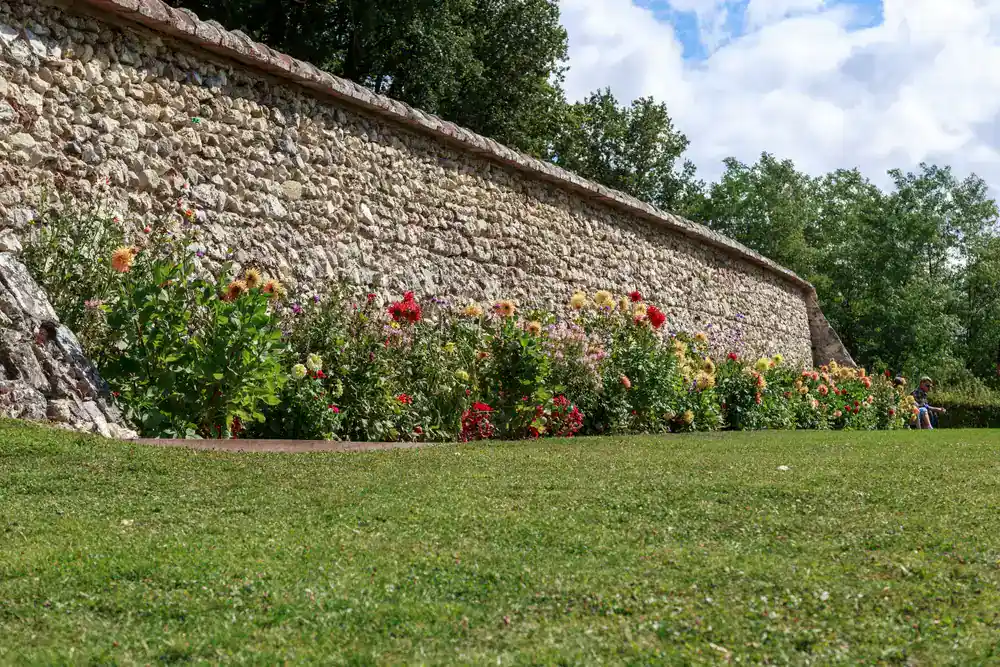
Natural stone is the “Elite” option. It’s heavy, it’s permanent, and it looks better with age. A well-built natural stone wall is a piece of art that just happens to be holding back ten tons of mud. While it takes more skill (and a bigger budget) to install, the “wow factor” and the 100-year lifespan are hard to argue with.
Don't Let Your Dirt Do the Talking
At the end of the day, a retaining wall is an investment in your home’s “spine.” It keeps the ground steady, the water away, and the curb appeal high. In Morris and Essex County, where the hills are steep and the rain is frequent, you don’t want to leave your property’s safety to a “good enough” solution.
If your current wall is starting to lean, or if you’re tired of watching your backyard slowly slide toward your back door, it’s time to call in the pros. We don’t just stack rocks; we engineer solutions that survive the Jersey winters and the summer storms.
Ready to turn that unusable slope into a stunning stone feature? We’re ready to help you reclaim your yard and protect your foundation.