
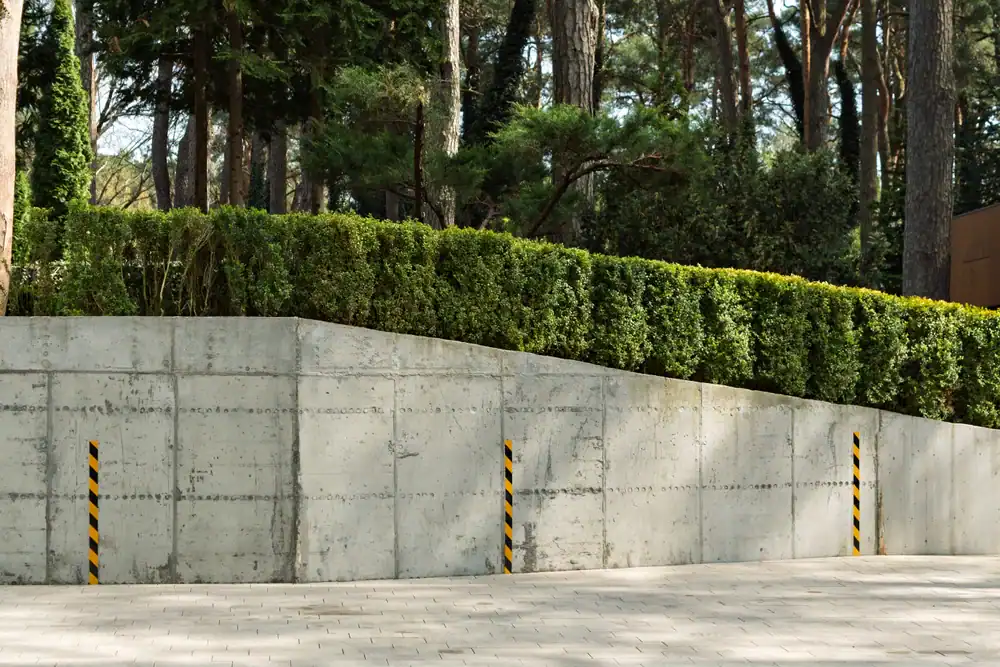

You’re not just stacking blocks. You’re redirecting thousands of gallons of water away from your foundation every time it rains.
A concrete retaining wall blocks or stone wall system does three things most homeowners don’t think about until it’s too late. First, it stops soil from washing into your driveway, garden beds, or neighbor’s yard. Second, it manages drainage so water doesn’t pool against your foundation or basement walls. Third, it creates flat, usable space where you currently have a slope you can’t mow, plant, or enjoy.
The difference between a wall that lasts 50 years and one that fails in five comes down to what you can’t see. Proper base preparation, drainage pipes behind the wall, and backfill material that doesn’t trap water. Most failures happen because someone skipped the boring parts to save a few hundred dollars.
In Belleville, where property taxes average over $11,000 a year, protecting your home’s foundation isn’t optional. Water damage from poor grading costs exponentially more to fix than building the wall right the first time.
We’ve been working in North and Central New Jersey long enough to know what fails here. Clay soil that shifts. Freeze-thaw cycles that crack poorly built walls. Drainage issues that turn a $5,000 project into a $15,000 repair three years later.
We’re licensed and insured, which matters more than it sounds. Any wall over four feet requires engineering and permits in New Jersey. We handle that process so you don’t have to figure out which forms to file with Belleville’s building department.
Our team stays small on purpose. You’re not getting a rotating crew of subcontractors who’ve never seen your property before. Same people, start to finish, with direct accountability if something needs adjustment.

We start with a site visit to look at your slope, drainage patterns, and soil conditions. You’ll get a written estimate that breaks down materials, labor, and any engineering or permit costs. No surprises later.
Once you approve, we pull permits if needed and schedule the work. Demo and excavation come first—we dig down to stable soil and create a level base with compacted gravel. This part isn’t glamorous, but it’s why the wall won’t sink or tilt in two years.
Then we install drainage pipes and fabric behind the wall before setting the first course of blocks or stone. Each row gets checked for level and backfilled with gravel that allows water to drain instead of building pressure. We use geogrid reinforcement on taller walls to tie everything into the hillside.
The final step is backfilling behind the wall, grading the area so water flows away from the structure, and cleaning up the site. We walk the job with you, answer any questions about maintenance, and make sure you’re clear on what to expect as the soil settles over the next few weeks.

Ready to get started?
Every retaining wall we build includes proper drainage—pipes, gravel backfill, and weep holes to prevent hydrostatic pressure. This isn’t an upgrade or add-on. It’s standard because walls without drainage fail.
You’ll get a choice of materials based on your budget and the look you want. Concrete retaining wall blocks run $20-$40 per square foot and work well for most residential projects. Natural stone costs more—$25-$75 per square foot—but it’s what people choose when they want the wall to look like it’s always been there. We’ll show you samples and explain the maintenance differences.
For walls over four feet, we bring in a structural engineer to design the system and stamp the plans. That costs between $500 and $2,000 depending on complexity, but it’s required by code and it’s how you know the wall is safe. We coordinate the engineering and permit process so you don’t have to track down paperwork or wait in line at the municipal building.
Belleville’s soil tends to be heavy clay, which holds water and creates pressure behind walls. We account for that in our drainage design and material selection. It’s a local detail that matters more than most contractors admit.

Most residential retaining walls in Belleville run between $4,000 and $15,000 depending on height, length, and material. A basic 3-foot concrete block wall might cost $5,000 for 20 linear feet. A 6-foot natural stone wall with engineering and terracing can easily hit $40,000 for a full backyard renovation.
Material choice drives a lot of the cost. Concrete blocks are the most affordable and durable option for most projects. Natural stone looks better but costs significantly more in both materials and labor because every piece has to be fit individually.
Engineering and permits add $500 to $2,500 for walls over four feet. That’s not optional in New Jersey—it’s code. Any contractor who tells you they can skip that step is setting you up for problems when you go to sell your house or if the wall fails and your insurance asks questions.
Yes, if your wall is over three to four feet tall. Belleville follows New Jersey building codes, which require permits for any retaining wall that exceeds a certain height or supports a significant load. The permit process also requires engineered plans stamped by a licensed structural engineer.
Most homeowners don’t realize this until they’re halfway through a project or trying to sell their home years later. An unpermitted wall can hold up a sale or force you to tear it down and rebuild it to code.
We handle the permit application as part of our service. It takes a few weeks for approval, but it protects you legally and ensures the wall is designed to handle the load and drainage conditions on your property. Skipping permits to save time or money almost always costs more in the long run.
Poor drainage is the number one cause. Water builds up behind the wall, creates hydrostatic pressure, and eventually pushes the wall forward until it bows, cracks, or collapses completely. This happens when contractors skip drainage pipes, use the wrong backfill material, or don’t include weep holes.
The second most common issue is inadequate base preparation. If the wall is built on topsoil or poorly compacted gravel, it will settle unevenly and start to lean or separate. A proper base requires excavation down to stable soil and a compacted gravel foundation that won’t shift.
Belleville’s clay soil makes drainage even more critical. Clay doesn’t drain well, so water sits behind the wall instead of filtering through. We use drainage pipes and gravel backfill on every job specifically to prevent this. It adds cost upfront but it’s the difference between a wall that lasts 50 years and one that fails in five.
Most residential retaining walls take one to two weeks from start to finish, not counting permit approval time. A simple 20-foot wall under four feet tall might be done in three to five days. Larger projects with multiple tiers, extensive drainage work, or difficult access can take two to three weeks.
Permit approval adds time on the front end—usually two to four weeks depending on how backed up Belleville’s building department is. We submit the application and engineered plans as soon as you approve the project so that timeline runs while we’re ordering materials and scheduling the crew.
Weather affects the schedule, especially in spring and fall when rain can delay excavation and base work. We’ll give you a realistic timeline upfront and keep you updated if anything changes. Most delays come from permit issues or material backorders, not the actual construction.
Sometimes. If the wall is leaning slightly or has a few cracked blocks, we can often stabilize it by improving drainage and replacing damaged sections. But if the wall is bowing significantly, sinking, or pulling away from the hillside, it usually needs to be rebuilt.
Repairing a failing wall is rarely cheaper than rebuilding it correctly. The underlying problem—poor drainage, inadequate base, or structural design issues—doesn’t go away just because you patch the visible damage. You end up paying twice: once for the repair and again a few years later for the full replacement.
We’ll give you an honest assessment during the site visit. If a repair will buy you a few more years and you’re planning to move soon, we’ll tell you. If the wall is a safety risk or the repair won’t last, we’ll recommend rebuilding. Either way, you’ll know what you’re getting before we start work.
Concrete retaining wall blocks are the most practical choice for most homeowners. They’re durable, affordable, and designed specifically for retaining wall applications. They last 50 to 100 years with minimal maintenance and they handle New Jersey’s freeze-thaw cycles without cracking.
Natural stone looks better if you’re going for a high-end landscape design, but it costs significantly more and requires more skilled labor to install. Stone walls also need occasional repointing as mortar degrades over time. If budget isn’t a concern and aesthetics matter, stone is worth considering.
Timber and brick are less common for good reason. Timber rots in New Jersey’s wet climate and needs replacement every 10 to 20 years. Brick looks nice but doesn’t handle lateral pressure as well as concrete blocks or stone, so it’s usually limited to shorter decorative walls. For a functional retaining wall that will last decades, concrete blocks are the best balance of cost, durability, and performance.
Other Services we provide in Belleville