
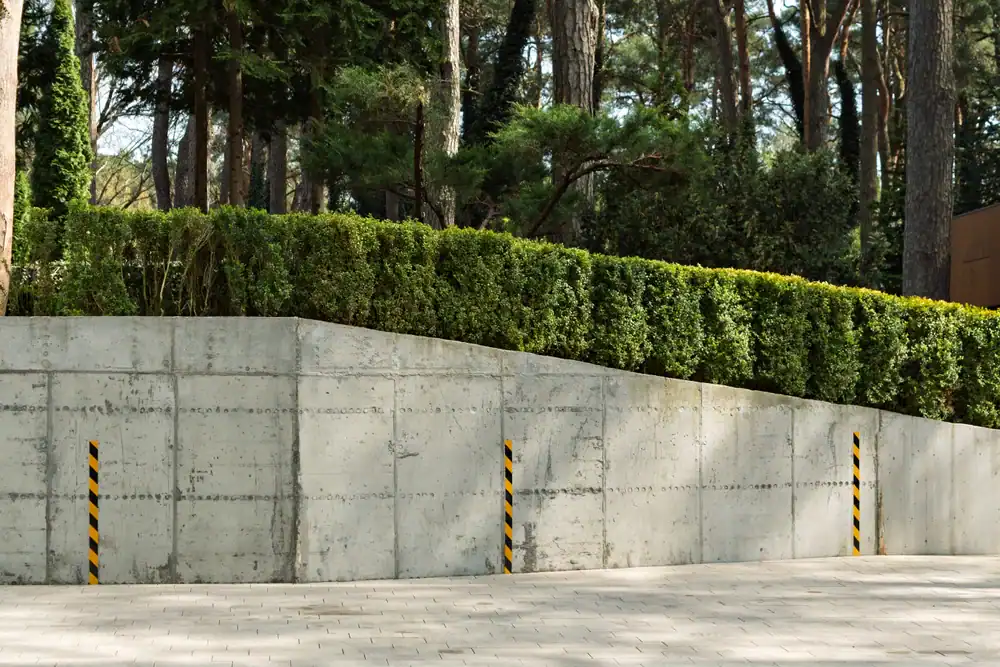

You get back the yard space you’ve been losing to slopes and erosion. A well-engineered retaining wall holds back soil, redirects water away from your foundation, and creates flat, usable areas where there used to be unusable hillside.
Most Glen Ridge properties sit on clay-heavy soil with natural elevation changes. Without proper grading and wall support, heavy rainfall pushes soil downhill, clogs drainage systems, and eventually threatens your foundation. That’s not a maybe—it’s what happens when water has nowhere to go.
The right wall stops that cycle. You’re not just stacking blocks—you’re installing a drainage system behind the wall, compacting base material correctly, and engineering the structure to handle both soil pressure and water flow. Done right, your wall lasts 30+ years. Done wrong, it leans within two seasons.
We’ve been handling masonry, foundation work, and site grading across New Jersey for years. We’re not a landscaping crew that dabbles in walls—we’re builders who understand soil mechanics, drainage engineering, and how Glen Ridge’s older properties require different approaches than new construction.
Most homes here were built before 1940. That means settled foundations, mature root systems, and existing drainage patterns you can’t ignore. We assess your property’s specific conditions before recommending a wall type, because a concrete block wall that works on flat land won’t perform the same way on a slope with poor drainage.
You’ll work with the same crew from estimate to completion. No subcontractors, no surprises, no change orders for things we should have caught during the site visit.

We start with a site assessment. That means looking at your slope angle, testing soil drainage, checking for underground utilities, and measuring elevation changes. You’ll know upfront if you need a permit (walls over 4 feet require one in most cases) and what type of wall makes sense for your property.
Next, we excavate and prep the base. This step determines whether your wall lasts three years or thirty. We dig below the frost line, compact crushed stone in layers, and install drainage pipe behind where the wall will sit. If water can’t escape, pressure builds up and pushes the wall outward—that’s why you see so many leaning retaining walls around older neighborhoods.
Then we build the wall itself using concrete retaining wall blocks, natural stone, or poured concrete depending on your site conditions and aesthetic preferences. Each course gets leveled and backfilled properly. We install weep holes or drainage gaps so water doesn’t get trapped. Finally, we backfill with drain stone, compact the soil, and grade everything so water flows away from both the wall and your foundation.
You’re left with a wall that does its job without requiring constant maintenance or emergency repairs two years later.

Ready to get started?
Every retaining wall project includes proper drainage installation—not optional, not an upsell. We install perforated drain pipe, drain stone backfill, and weep holes or drainage gaps as standard. Without drainage, even the best-built wall fails within a few seasons.
You also get engineered base preparation. We excavate below frost depth, compact crushed stone in lifts, and ensure the foundation can handle the load. Glen Ridge’s clay soil expands when wet and contracts when dry, so we account for movement in our base design.
For taller walls or problem slopes, we incorporate geogrid reinforcement. These fabric layers tie into the soil behind the wall and distribute pressure more evenly. It’s the difference between a wall that holds and one that bows outward after the first major rainstorm.
Material options include segmental retaining wall blocks (the most common choice for residential projects), natural stone (for a high-end look that complements Glen Ridge’s historic homes), and poured concrete (for commercial applications or walls requiring maximum strength). We’ll recommend what makes sense for your specific site—not what’s easiest for us to install.

A properly built retaining wall lasts 30 to 50 years in Glen Ridge if it has correct drainage and a solid foundation. The walls that fail early almost always have drainage problems—water builds up behind the wall, creates pressure, and pushes the structure outward until it collapses.
Glen Ridge’s clay soil makes drainage even more critical. Clay doesn’t absorb water well, so rainfall sits behind your wall instead of draining away naturally. That’s why we install perforated pipe, drain stone, and weep holes on every project.
The wall material matters too. Concrete retaining wall blocks typically last 40+ years. Natural stone can last 50+ years if installed correctly. Timber walls might only give you 15-20 years before rot becomes an issue. You’re making a long-term investment either way, so choosing materials that match your property’s conditions makes more sense than choosing based on upfront cost alone.
You need a permit in Glen Ridge for any retaining wall over 4 feet in height, measured from the bottom of the base to the top of the wall. Walls under 4 feet typically don’t require permits, but you should still check with the building department before starting work.
If your wall is near a property line, you may need additional approvals regardless of height. Glen Ridge has setback requirements that dictate how close structures can be to boundary lines. Violating setbacks can result in fines and forced removal of the wall.
Even if your project doesn’t require a permit, hiring a contractor who understands local building codes protects you. We handle permit applications when needed and ensure the wall meets structural requirements. That matters if you ever sell your home—unpermitted work can complicate closings and reduce your property value.
Poor drainage causes most retaining wall failures in Glen Ridge. When water can’t escape from behind the wall, hydrostatic pressure builds up and pushes the structure outward. You’ll see bulging, leaning, or cracks forming—all signs that water is winning the battle.
Inadequate base preparation is the second most common cause. If the foundation wasn’t compacted properly or doesn’t extend below the frost line, the wall shifts as soil freezes and thaws. Glen Ridge winters are cold enough to cause frost heave, which lifts and displaces structures that aren’t anchored correctly.
Using the wrong wall type for your slope also leads to failure. Gravity walls work for shorter heights, but taller walls need reinforcement like geogrid or a cantilever design. We see DIY projects fail constantly because homeowners don’t account for soil pressure calculations. A 4-foot wall holding back soil isn’t just supporting 4 feet of weight—it’s resisting tons of lateral pressure that increases with height.
Retaining walls in Glen Ridge typically cost $20 to $40 per square foot installed, depending on wall height, material choice, and site conditions. A basic 3-foot tall block wall might run $3,000-$5,000 for a 50-foot length. Taller walls or natural stone installations can easily reach $10,000-$15,000 for the same length.
Several factors affect pricing. Difficult access increases labor costs—if we can’t get equipment to the site, everything takes longer. Poor soil conditions require more extensive base prep. Walls over 4 feet need engineering and permits, which add to the total. Drainage complexity matters too—if your property has multiple water sources or severe runoff issues, we’ll need more extensive drainage solutions.
Repairing a failed wall almost always costs more than building it right the first time. We’ve seen homeowners spend $2,000-$3,000 on temporary fixes, only to need a complete rebuild within a few years. That’s why material quality and proper installation technique matter more than finding the lowest bid. You’re protecting a property worth $700,000+—the wall should reflect that investment.
Block walls use interlocking concrete retaining wall blocks that stack without mortar. They’re the most common choice for residential retaining walls because they’re cost-effective, relatively quick to install, and handle movement better than rigid structures. The blocks have a textured face that looks finished without additional work.
Poured concrete walls are solid, monolithic structures that offer maximum strength. They work well for taller walls or commercial applications where you need serious load-bearing capacity. The downside is cost—poured walls require formwork, reinforcement, and longer cure times. They’re also less forgiving if soil movement occurs, since concrete cracks rather than flexes.
For most Glen Ridge properties, segmental block walls make the most sense. They handle the freeze-thaw cycles we get each winter, they allow for minor settling without cracking, and they cost significantly less than poured concrete. We recommend poured walls when you’re dealing with extreme height differences or when the wall needs to support additional weight like a driveway or structure above it.
It depends on what’s causing the problem and how far the damage has progressed. Minor issues like a few loose blocks or small cracks can often be repaired without rebuilding the entire wall. But if the wall is leaning more than a few inches, bulging outward, or showing signs of foundation failure, replacement usually makes more sense than attempting repairs.
The key question is whether the original wall has proper drainage. If it doesn’t—and most failing walls don’t—repairs won’t solve the underlying problem. You’ll spend money stabilizing the wall temporarily, but water pressure will continue causing damage. In those cases, rebuilding with correct drainage actually costs less long-term than repeated repair attempts.
We assess the wall’s foundation, check for drainage systems, and measure how much movement has occurred. If the base is solid and we can address the drainage issues, repairs might work. If the foundation has failed or the wall has shifted significantly, you’re better off rebuilding. We’ll give you an honest assessment either way—there’s no point in selling you a repair that won’t last.
Other Services we provide in Glen Ridge