
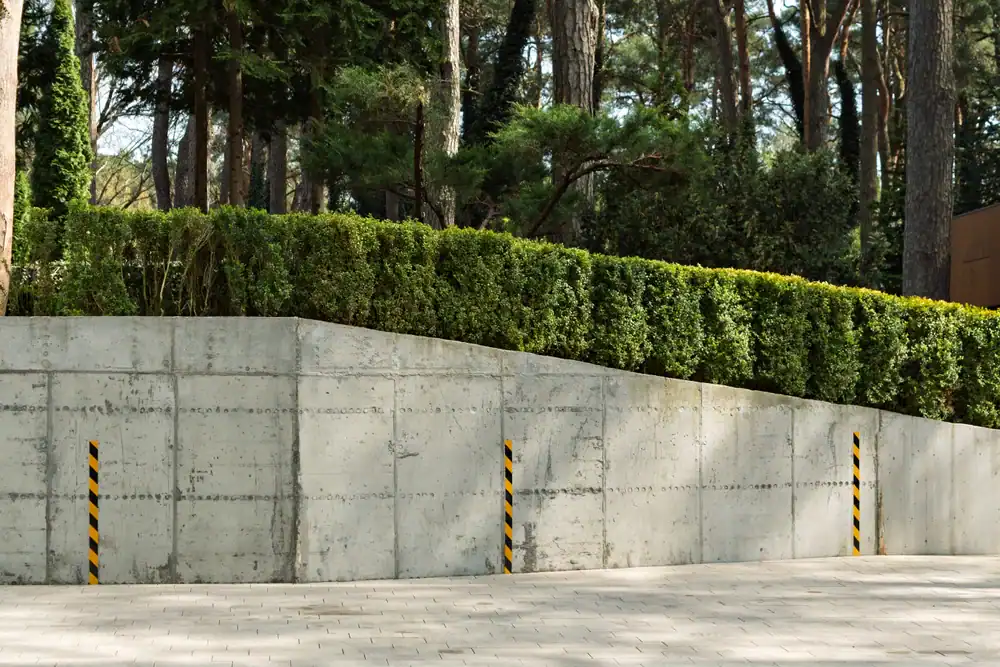

You get a yard that doesn’t wash away every time it rains. Your soil stays where it belongs. Your foundation stops taking on water from uphill runoff.
The right retaining wall does more than hold back dirt. It redirects water away from your house, creates usable flat space where you had a slope, and stops you from losing topsoil every spring. When it’s built with proper drainage and the right concrete retaining wall blocks, it handles New Jersey’s freeze-thaw cycles without cracking or bowing.
Most walls fail because of water pressure building up behind them. That’s why drainage isn’t optional. It’s the difference between a wall that lasts 30 years and one that starts leaning after three winters.
We’ve been handling masonry and retaining wall installation across Lincoln Park, NJ for nearly two decades. We’re certified, we’re insured, and we’ve seen what happens when walls are built without proper drainage or foundation prep.
Lincoln Park’s soil and terrain aren’t forgiving. You’ve got properties on slopes, older homes built before modern grading standards, and weather that swings from 90 degrees to below freezing in the same year. That means your retaining wall needs to be engineered for this specific environment, not just thrown together with whatever blocks are on sale.
We don’t subcontract the work. We don’t disappear after the estimate. You get the same crew from start to finish, and we handle permits, inspections, and all the details that most homeowners don’t even know they need to worry about.

First, we come out and look at your property. We’re checking slope, soil type, drainage patterns, and whether you need a permit. In New Jersey, any wall over four feet requires one. We measure, take photos, and talk through what you’re trying to accomplish.
Then we give you a written estimate that breaks down materials, labor, and timeline. No surprises. If you need engineered plans for permitting, we handle that too. Once you approve, we schedule the work and pull permits if required.
The actual installation starts with excavation and base prep. This is where most contractors cut corners. We dig deep enough, compact the base properly, and install drainage behind the wall before any blocks go up. Then we build the wall in courses, backfill with gravel for drainage, and make sure water has somewhere to go that isn’t into your basement.
Depending on the size, most residential retaining walls take anywhere from three days to two weeks. You’ll know the timeline upfront, and we’ll keep you updated if weather or site conditions change anything.

Ready to get started?
You’re getting a full site assessment, material recommendations based on your budget and site conditions, and a written estimate before any work starts. We’re not upselling you on stone if concrete blocks make more sense for your situation.
The installation includes proper excavation, compacted base material, drainage system installation, and the retaining wall itself built to code. We use concrete retaining wall blocks for most projects because they’re durable, cost-effective, and handle New Jersey weather better than timber. If you want natural stone for aesthetics, we do that too, but we’ll be honest about the cost difference.
Lincoln Park properties often deal with water runoff from higher elevations. If your neighbor’s yard drains into yours, or you’re at the bottom of a slope, that affects how we design your wall. We’re accounting for that water and making sure it doesn’t pool behind your wall or flood your foundation. That means gravel backfill, weep holes, and sometimes a perforated drain pipe depending on how much water we’re dealing with.
You also get cleanup when we’re done. We haul away excavated soil, leftover materials, and anything else that doesn’t belong in your yard. The job isn’t finished until your property looks better than when we started.

Most residential retaining walls in Lincoln Park run between $4,000 and $15,000 depending on height, length, and material. A basic 50-foot concrete block wall that’s four feet tall usually lands around $8,000 including materials, labor, and drainage.
Concrete retaining wall blocks cost less than natural stone. You’re looking at roughly $20 to $40 per square foot for concrete versus $25 to $75 per square foot for stone. Timber is cheaper upfront but doesn’t last as long in New Jersey’s climate, so you end up replacing it sooner.
Height matters because anything over four feet requires engineering and permits, which adds to the cost. If your wall needs to be six feet tall, you’re paying for engineered plans, permit fees, and more intensive foundation work. But that’s not optional. It’s code, and it’s there because taller walls carry more load and need proper design to stay standing.
Yes, if your wall is four feet or taller. Lincoln Park follows New Jersey building codes, which require permits and inspections for retaining walls above a certain height. Permit fees typically run between $50 and $500 depending on the scope of work.
Even if your wall is under four feet, you might still need a permit if it’s near a property line or if it’s supporting a load like a driveway or patio. The safest move is to check with the town before you start digging. We handle permit applications as part of our service, so you don’t have to deal with the paperwork or figure out what the town needs.
Skipping permits might seem like a shortcut, but it causes problems when you sell your house. Unpermitted work shows up in inspections, and buyers either walk away or demand that you fix it. It’s not worth the risk, especially when permits aren’t that expensive and the process is straightforward if you know what you’re doing.
Water pressure is the number one reason. When water builds up behind a retaining wall without anywhere to go, it creates hydrostatic pressure that pushes the wall forward. Over time, that pressure causes bowing, cracking, or complete failure.
Proper drainage fixes this. That means gravel backfill, weep holes, and sometimes a perforated drain pipe at the base of the wall. The goal is to let water escape instead of building up pressure. Most failing walls we see were built without drainage or with inadequate drainage that clogged over time.
The other common issue is poor foundation work. If the base isn’t deep enough, compacted properly, or built on stable soil, the wall will shift. New Jersey’s freeze-thaw cycles make this worse because the ground moves seasonally. A wall that looks fine in summer can start leaning after a few hard winters if the foundation wasn’t done right from the start.
Concrete retaining wall blocks hold up best in New Jersey’s freeze-thaw cycles. They don’t rot like timber, they’re more affordable than natural stone, and they’re engineered to interlock and handle ground movement without falling apart.
Segmental retaining wall blocks are what we use now because they’re designed specifically for this application. They’re heavy enough to stay in place, they have built-in drainage features, and they come in different styles if you care about aesthetics. They also don’t require mortar, which means they can flex slightly with ground movement instead of cracking.
Natural stone looks great and lasts forever if installed correctly, but it costs significantly more and takes longer to build. Timber is the cheapest option upfront, but it rots in 10 to 15 years, especially in areas with moisture. If you’re trying to get the most life out of your investment without overspending, concrete blocks are the right call for most Lincoln Park properties.
Most residential retaining walls take between three days and two weeks depending on size, height, and site conditions. A straightforward 30-foot wall that’s three feet tall might be done in three to five days. A larger wall that requires permits, engineering, and extensive drainage work can take two weeks or more.
Weather affects the timeline. If it rains heavily during excavation or base prep, we have to wait for the ground to dry out before we can compact the base properly. Rushing that step causes problems later, so we’d rather delay a day or two than build on a foundation that isn’t ready.
Access also matters. If we can get equipment into your backyard easily, the job moves faster. If we’re hand-digging in a tight space or hauling materials through your side yard, that adds time. We’ll give you a realistic timeline during the estimate based on what we see on your property, and we’ll keep you updated if anything changes during the job.
It depends on what’s failing and why. If the wall is leaning more than a few inches, cracking severely, or showing signs of foundation failure, replacement is usually the better option. Repairing a wall that’s structurally compromised often costs almost as much as rebuilding it, and you don’t get the same lifespan.
Minor issues like a few loose blocks, surface cracks, or cosmetic damage can sometimes be repaired if the foundation and drainage are still solid. We’ll assess the wall, figure out what’s causing the problem, and give you an honest recommendation. If a repair will buy you another 10 years, we’ll tell you. If it’s a temporary fix on a wall that’s going to fail anyway, we’ll tell you that too.
Most older timber retaining walls in Lincoln Park are past the point of repair. Wood doesn’t hold up well in New Jersey’s wet climate, and once it starts rotting, there’s no fixing it. In those cases, replacing it with concrete retaining wall blocks makes more sense because you’re solving the problem permanently instead of patching it for another few years.
Other Services we provide in Lincoln Park