
When siding is installed correctly, you stop thinking about it. No buckling panels after the first hard winter. No water finding its way into the wall cavity after a nor’easter rolls through. No mystery rot showing up behind the trim two years later. That’s the baseline and it’s what every Caldwell homeowner should expect.
The local conditions here accelerate siding failure in ways that contractors from outside the area often miss. Caldwell sits in northwestern Essex County, where freeze-thaw cycles hit hard every winter, and nearly a quarter of borough properties carry a severe flooding risk. That combination seasonal ground movement, heavy moisture exposure, and older housing stock built before modern moisture barriers existed means siding that was installed without proper flashing and a continuous water-resistive barrier is already working against you. It’s not a question of if it fails. It’s when.
Good siding installation in Caldwell isn’t just about curb appeal. It’s about keeping the structure sound. With home values in the borough sitting near $687,000 and rising, what’s behind your siding is worth protecting. A properly installed exterior with the right material for your home’s exposure and a workmanship warranty that actually covers what can go wrong is one of the few home improvement investments that pays you back at resale while working for you every single day in between.
Proline Construction is a family-owned general contracting company that has been serving homeowners across northern New Jersey since 2018. We hold NJ HICB license #13VH09838700, earned BBB Accreditation in January 2025, and carry GAF Preferred Contractor status credentials you can verify independently before you ever pick up the phone.
We work throughout Essex County, including Caldwell and the surrounding communities of West Caldwell, North Caldwell, Essex Fells, and Roseland. That means we’re familiar with the housing stock here the older homes, the substrate conditions, the local permit process through the Caldwell Building Department not learning it on your dime.
Every project comes with a full warranty covering both materials and workmanship, because most siding failures are installation errors, not product defects. You get a free consultation, honest recommendations, and a crew that communicates clearly from start to finish whether that’s a call, a text, or a conversation on-site.
It starts with a free on-site consultation. We look at your existing siding, the substrate condition underneath, the moisture barrier, and how water moves around your windows, doors, and any penetrations. For older Caldwell homes many of which were built well before modern installation standards this inspection step is where we find what other contractors miss. If there’s rot, compromised sheathing, or a failed moisture barrier behind your current siding, we tell you before anything gets covered up.
From there, we walk you through your material options based on your home’s actual exposure. Homes on lower-lying streets in Caldwell with higher flood risk have different needs than homes on elevated lots. Vinyl, fiber cement, and composite each perform differently under this area’s climate conditions, and we’ll explain the tradeoffs clearly so you can make a decision that makes sense for your home and your budget.
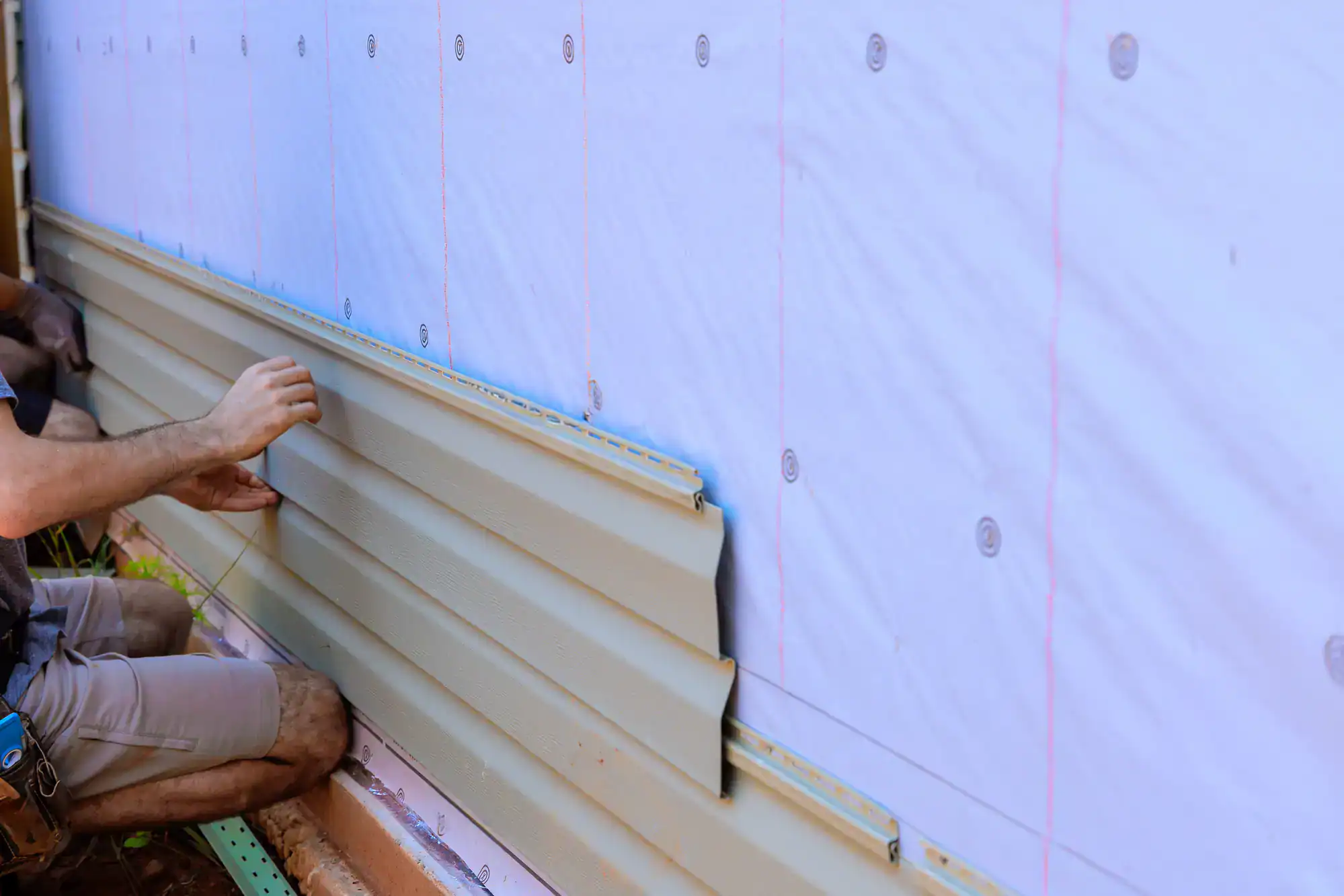
Once the scope is agreed on, we pull the required permits through the Caldwell Building Department that’s not optional, and any contractor who skips it is leaving you exposed. Installation follows a defined sequence: substrate repair if needed, moisture barrier, flashing at every transition point, then siding. When the crew leaves, the site is clean and the work is done right. If anything comes up after the job is complete, the warranty is there and we pick up the phone.
Ready to get started?
Request a callback

We install vinyl siding, fiber cement siding, and composite siding for residential and commercial properties throughout Caldwell and the surrounding Essex County area. Each material has a real use case depending on your home’s age, exposure, and what you’re trying to accomplish and we’ll tell you which one actually fits your situation rather than defaulting to whatever has the highest margin.
Fiber cement is particularly well-suited to Caldwell homes with moisture exposure concerns. It doesn’t absorb water, resists rot, and holds up against the kind of sustained humidity and freeze-thaw stress this area delivers every year. For homes near lower-elevation streets where flooding risk is a documented factor, fiber cement paired with a properly installed moisture barrier is the most structurally sound choice available. Vinyl remains a strong option for homes where budget is a priority and exposure conditions are more moderate installed correctly, with appropriate expansion gaps and nails set to the right depth, it performs reliably for decades.
Beyond full replacement, we also handle targeted siding repair for storm damage, isolated rot, and impact damage. If a nor’easter takes out a section of your exterior or a branch leaves a crack you can’t ignore, we assess the damage honestly and tell you whether a repair gets the job done or whether the surrounding panels are already too far gone to make repair the right call. No upsell, no pressure just a straight answer.
Yes. Siding replacement in Caldwell requires a building permit under the New Jersey Uniform Construction Code, which governs exterior alterations on residential properties statewide. You’ll need to apply through the Caldwell Building Department before work begins not after. Any contractor who tells you permits aren’t necessary for a siding job in this borough is either cutting corners or doesn’t know the local requirements, and either way that’s a problem you don’t want to inherit.
The permit requirement exists for good reason. It ensures the work is inspected and meets code which matters especially in Caldwell, where a significant portion of the housing stock is older and substrate conditions vary widely. If you sell your home down the road, unpermitted work can surface during the buyer’s inspection and create real complications. We handle the permit process as part of every full siding replacement project. You don’t need to navigate the Caldwell Building Department on your own.
The general rule most contractors use is this: if the cost of targeted repairs approaches 25 to 30 percent of what a full replacement would cost, replacement almost always makes more financial sense over the long run. But the more important question is what’s happening underneath. Siding that looks rough on the surface might be hiding substrate damage, failed moisture barriers, or rot that a surface repair won’t fix. Covering that up with new panels just delays a bigger problem.
For Caldwell homes particularly older properties that have gone through multiple siding cycles we always inspect the substrate before recommending anything. If the sheathing is sound and the damage is isolated to a few panels or a specific section, repair is a perfectly valid answer. If we find moisture infiltration that has spread into the wall cavity, that changes the conversation. The free consultation is where we figure that out, and we’ll give you a straight answer either way rather than defaulting to the option that costs more.
Caldwell’s climate puts real stress on exterior materials. Freeze-thaw cycles through the winter cause expansion and contraction in siding panels and vinyl in particular is sensitive to this. When vinyl is installed with nails driven too tight, those panels have nowhere to move when temperatures drop, and they buckle or crack over time. Properly installed vinyl with correct nail placement and adequate expansion gaps handles the climate well. The installation technique matters as much as the material itself.
Fiber cement is more dimensionally stable through temperature swings and doesn’t absorb moisture, which makes it a strong choice for Caldwell homes with higher flood exposure or those on lower-lying streets where standing water is a seasonal reality. It’s heavier and costs more upfront, but it holds up better over a longer timeline in this climate. We’ll walk you through both options during the consultation based on your home’s specific exposure there’s no one-size-fits-all answer, and we won’t pretend there is.
For a standard single-family home in Caldwell, a full siding replacement typically runs between three and seven days of active installation, depending on the size of the home, the material being installed, and what we find during substrate inspection. If there’s rot or sheathing damage that needs to be addressed before new siding goes on which is not uncommon in older Essex County homes that adds time to the project. We build that into the scope upfront so you’re not surprised mid-project.
Timing also matters seasonally. Spring and fall are the optimal windows for siding installation in this area moderate temperatures allow materials to acclimate properly and sealants to cure correctly. Summer work is entirely doable, but scheduling books up faster during peak season. If you’re planning a project before fall, getting a consultation scheduled sooner rather than later gives you more flexibility on timing. We keep you informed throughout the project on schedule and progress, so you’re never left wondering what’s happening.
Start with the basics before anything else: verify the contractor holds a valid NJ Home Improvement Contractor Business registration. You can check any contractor’s license on the NJ Division of Consumer Affairs website in under a minute. The 2024 update to New Jersey’s contractor licensing law added compliance bond and workers’ compensation insurance requirements so you also want to confirm those are current. Hiring an uninsured or unregistered contractor in Caldwell can leave you personally liable for on-site injuries and gives you no recourse under the NJ Consumer Fraud Act if the work is defective.
Beyond credentials, pay attention to how the contractor communicates during the estimate process. Do they inspect the substrate before quoting, or do they just look at the surface? Do they explain the permit process, or avoid the topic? Do they provide a written estimate with a clear scope of work? A contractor who is vague about what’s included before the job starts will be vague about it after. Our license number is #13VH09838700 verifiable before you commit to anything.
In Caldwell’s current market, yes and the numbers back it up. The 2024 Cost vs. Value Report shows siding replacement returns between 80 and 95 cents on every dollar spent at resale, with fiber cement specifically returning around 87 percent. In a borough where the median home value has reached nearly $687,000 and appreciated over 10 percent in a single year, that return is meaningful. Caldwell’s real estate market scores 80 out of 100 for competitiveness on Redfin homes here are being evaluated carefully by buyers, and exterior condition is one of the first things that shapes a buyer’s perception before they ever walk through the door.
Beyond resale, new siding does real daily work reducing air infiltration, improving moisture protection, and lowering energy costs. For Caldwell homeowners who aren’t planning to sell anytime soon, the value is in what you’re no longer dealing with: no rotting trim, no water finding its way into the wall assembly, no panels buckling after a hard winter. That’s worth something independent of what the market does.
Other Services we provide in Caldwell