Summary:
You’ve noticed water stains on your ceiling. Or maybe a few shingles in the yard after that last storm. Now you’re wondering if this is a quick fix or the beginning of something bigger.
The gap between what needs a patch and what needs a full roofing replacement isn’t always obvious. But it matters. A lot. Because the wrong call either wastes money on repairs that won’t hold, or pushes you into replacing your roof when you didn’t actually need to yet.
Here’s what you need to know to make the right decision for your roof, your budget, and your timeline.
Replace Roof vs Repair: Making the Right Decision for Your Home
The decision between repair and replacement comes down to three things: how much of your roof is affected, how old it is, and what it’ll cost you either way.
If damage is isolated to one small area, a repair usually makes sense. A few missing shingles from wind. A cracked vent boot. Flashing that’s separated in one spot. These are problems we can fix in an afternoon.
But when you’re seeing issues in multiple places, or the same problem keeps coming back, that’s your roof telling you something different. The underlayment’s failing. The shingles have lost their grip. The system as a whole is breaking down. At that point, patching one spot just buys you time until the next leak shows up somewhere else.
When Roof Age Decides for You
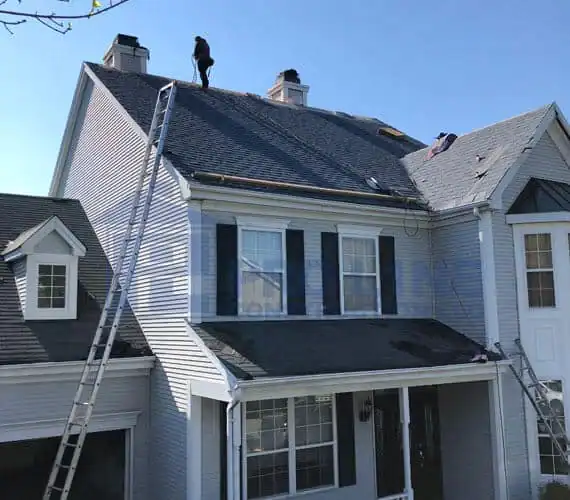
Age doesn’t lie. Most asphalt shingle roofs in New Jersey last somewhere between 20 and 25 years. Not 30 like you might see advertised for warmer climates. Our freeze-thaw cycles, nor’easters, and summer storms take their toll faster than steady weather does.
If your roof is pushing 20 years old and you’re starting to see problems, a roof replacement is probably the smarter move even if the damage looks minor right now. Here’s why. An aging roof doesn’t fail all at once. It fails in stages. First, you get a leak in the valley. You patch it. Six months later, you’ve got shingles curling on the south-facing slope. You replace those. Then the flashing around the chimney starts letting water through.
Each repair costs you a few hundred to maybe a thousand dollars. Add them up over two or three years, and you’ve spent $3,000 to $4,000 keeping a roof alive that needed replacing from the start. Meanwhile, a full roof replacement in Essex County runs $12,000 to $18,000 for a typical home. The math starts to make sense when you look at it that way.
The other factor is what happens underneath. When a roof gets old, water finds its way to the decking. You might not see it from inside yet, but it’s there. Rotting plywood. Compromised structure. By the time you realize you’ve got a bigger problem, you’re paying for both the roof and the repairs to what’s underneath. Getting ahead of it saves you that second bill.
If you’re not sure how old your roof is, check your home improvement records. Or ask a roofing contractor to take a look. We can usually tell from the condition of the shingles and the style of installation.
The 30% Rule and What It Means for Your Wallet
There’s a guideline roofing contractors use that homeowners should know about too. If the cost to repair your roof is going to run more than 30% of what a full replacement would cost, you’re better off replacing.
Let’s say a full roof replacement for your home would cost $15,000. Thirty percent of that is $4,500. If you’re looking at repairs that’ll hit $5,000 or $6,000, you’re spending replacement money on a temporary fix. That doesn’t make sense for most people.
This comes up more often than you’d think. You call a contractor about a leak. We get up there and find that the problem isn’t just the spot where water’s coming in. The underlayment’s compromised in a 15-foot section. The flashing needs redoing around three penetrations. A couple areas of decking are soft. Suddenly you’re not talking about a $600 repair. You’re talking about $4,000 to $7,000 in work. And you still have a 20-year-old roof.
The honest roof replacement contractor tells you this upfront. We show you what we found, explain what it’ll take to fix it properly, and give you the comparison. Repair cost versus replacement cost. Expected lifespan of each option. What you’re actually getting for your money.
That’s the conversation that separates a contractor who’s working for you from one who’s just trying to close a sale. If someone’s pushing you toward the more expensive option without showing you the math, that’s a red flag. If they’re recommending repairs when replacement makes more sense long-term, that’s a different kind of red flag.
You want the contractor who walks you through it, answers your questions, and lets you make the call based on real information.
Want live answers?
Connect with a Proline Construction expert for fast, friendly support.
Choosing a Roof Replacement Contractor: Essential Qualifications
Once you’ve decided replacement is the right move, the next decision is who’s going to do the work. This is where a lot of homeowners make expensive mistakes.
The lowest bid isn’t always the best value. The fastest timeline isn’t always realistic. And the smoothest sales pitch doesn’t guarantee quality work. What matters is whether the roof replacement contractor has the right qualifications, the right insurance, and the right track record.
In New Jersey, every roofing contractor needs to be registered as a Home Improvement Contractor with the Division of Consumer Affairs. That’s not optional. It’s state law. If they can’t show you that registration number, you shouldn’t be talking to them. Licensed contractors have to carry liability insurance and workers’ compensation coverage. If something goes wrong on your property, you’re protected. Unlicensed contractors don’t have those requirements, which means any accidents or damage fall on you.
Why GAF Certification Actually Matters
You’ll see a lot of contractors mention manufacturer certifications. Some of that is marketing. But some of it actually means something. GAF certification is one that’s worth paying attention to.
GAF is one of the largest roofing material manufacturers in the country. Their preferred contractor program has real standards. Contractors have to prove they’re properly licensed and insured. They have to maintain a solid reputation with verifiable customer reviews. And they have to commit to ongoing training on installation methods and materials.
Less than 5% of roofing contractors qualify for GAF’s Master Elite status. That’s not because the program is exclusive for the sake of being exclusive. It’s because most contractors don’t want to meet the requirements. Ongoing training takes time. Maintaining high customer satisfaction takes work. Staying current on installation methods means you can’t cut corners.
When you hire a GAF preferred contractor for your roofing replacement, you’re also getting access to better warranties. Standard material warranties cover defects in the shingles themselves. Enhanced warranties through certified contractors cover both materials and workmanship. That’s the difference between coverage that protects you if a shingle is defective, and coverage that protects you if something goes wrong with how it was installed.
The other thing certification tells you is that the contractor plans to be around. Manufacturers don’t certify fly-by-night operations. They certify established businesses that have been operating for years and plan to keep operating. That matters when you’re making a decision that affects your home for the next 20 to 30 years.
It’s not the only factor. But it’s a good signal that you’re dealing with someone who takes the work seriously.
Roof Replacement Company Selection: Questions to Ask
Before you commit to any roof replacement company, you need clear answers to specific questions. Not vague assurances. Not “we’ll take care of it.” Actual answers.
Start with the basics. Are you licensed and insured? Can I see your Home Improvement Contractor registration number? Do you carry workers’ compensation coverage? If they hesitate on any of these, walk away.
Then get into the details of your project. What’s included in the estimate? Does that cover tear-off and disposal of the old roof? What about permits? Are there any costs that aren’t in this number? You need to know if the quote you’re looking at is the actual price or just the starting point.
Ask about the timeline. When would you start? How long will the work take? What happens if you find damage to the decking once you remove the old roof? That last one is important. Hidden damage is common, especially on older roofs. You want to know upfront how that’ll be handled and what it’ll cost.
Find out who’s doing the work. Will it be your crew or subcontractors? How many people will be on site? What’s your process for cleanup and protecting the property? These aren’t small details. They affect how the project goes and how much disruption you’ll deal with.
And ask about communication. How will you keep me updated? Who do I contact if I have questions during the project? What’s your response time if something comes up? The contractors who have good answers to these questions are usually the ones who run smooth projects. The ones who get vague or defensive are the ones who create headaches.
Don’t feel awkward asking. This is your home and your money. Any contractor worth hiring will respect that you’re doing your homework.
Making Your Roof Decision With Confidence
Deciding between repair and replacement comes down to honest assessment. How much damage you’re dealing with. How old your roof is. What the math looks like when you compare short-term fixes to long-term solutions.
The right contractor makes that decision clearer, not harder. We show you what we’re seeing, explain what it means, and give you real numbers to work with. We don’t push you toward the most expensive option, and we don’t minimize problems that need attention.
If you’re in Essex County and you need that kind of straight talk about your roof, Proline Construction can help. Free consultation. No pressure. Just honest evaluation and clear options so you can make the right call for your home.