Summary:
Where Your Patio Money Really Goes (Spoiler: It's Not All Fancy Stones)
The price tag on a patio isn’t just about the shiny pavers on top; it’s about the dirt, the sweat, and the engineering underneath. In Northern NJ, your biggest cost drivers are site prep and what we call “the foundation.” Think of your patio like a house—if you build it on a bad base, the whole thing is going to move faster than a Jersey driver when the light turns green.
If your yard has more slopes than an Olympic ski run, you’re going to pay for grading. If your soil is that classic NJ clay that holds onto water like a hoarder, you’re paying for proper base work to make sure your patio doesn’t become a topographical map of the Himalayas after one freeze. Skipping the “underground” stuff to save a buck is the fastest way to end up with a sinking mess by next spring.
Material choice is the “fun” part of the budget, but don’t let the catalogs fool you. Natural stone looks amazing but carries a “luxury” labor cost because fitting those pieces together is basically an adult jigsaw puzzle. Concrete pavers are the budget-friendly heroes of the industry—durable, uniform, and much faster to install. The key is picking the material that survives the 40-plus freeze-thaw cycles we get every year without cracking under the pressure.
The "Real Talk" Price Tag: What to Expect in 973 and 201
Let’s get specific, because “it depends” is a terrible answer. For a standard 400-square-foot paver patio in towns like Morristown or Montclair, you’re typically looking at somewhere between $3,200 and $6,000. This range assumes your yard is relatively flat and doesn’t require us to relocate a small mountain or a family of stubborn gnomes before we start.
If you choose concrete pavers, you’re chilling on the lower end of that budget. Natural stone like Bluestone? That’s going to push you toward the higher end because of the extra labor required to cut and fit each unique piece. Most “standard” estimates include the essentials: excavation, a compacted gravel base, the pavers, edge restraints, and that magical polymeric sand that keeps the weeds out.
What usually isn’t in the “base price” are the extras that make a patio feel like a destination. Lighting, fire pits, and retaining walls are like the “guacamole” of the masonry world—they cost extra, but they make everything better. If your budget is tight, focus on a solid, well-built slab first. You can always add the fancy fire pit later when your “patio fund” has recovered from the initial excitement.
Materials That Won't Make Your Wallet Cry
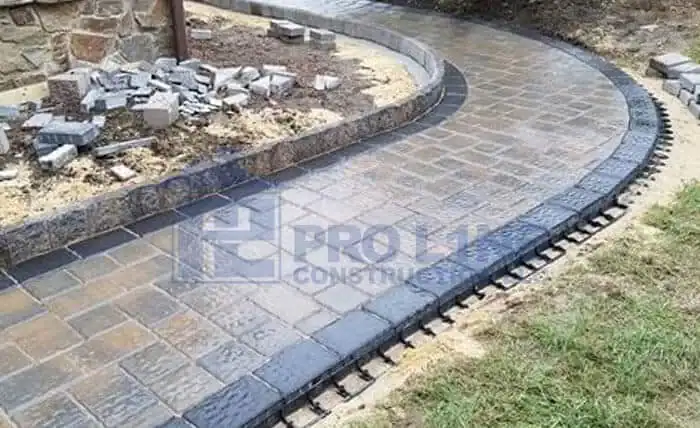
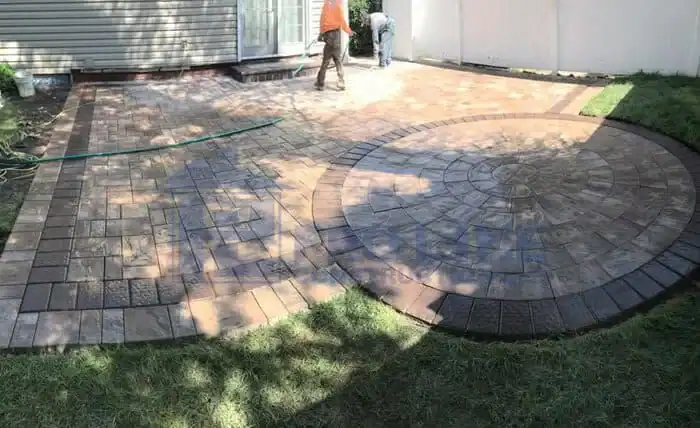
Concrete pavers are the undisputed workhorses of the New Jersey patio scene. They are affordable, they come in every color from “Classy Grey” to “Tuscan Sunset,” and they hold up incredibly well against snow shovels and rock salt. At roughly $8 to $20 per square foot installed, they are the smartest move for a homeowner who wants a high-end look without the high-end drama.
If you’re a traditionalist, brick pavers offer a classic look that says, “I’ve been here since the 1800s,” even if you just moved in last week. They age beautifully and fit perfectly with the colonial architecture common in Essex County. You’re looking at about $14 to $24 per square foot. Plus, if a brick cracks, you just swap it out—it’s the only home repair that’s actually as easy as it sounds.
Poured concrete is the “budget king” at $5 to $16 per square foot, but we have to give you the “Jersey Warning.” In a climate that freezes and thaws like a manic freezer, large slabs of concrete will crack eventually. It’s not a threat; it’s a promise. You can minimize it with control joints, but if you hate cracks, stick with pavers—they can “flex” with the ground’s mood swings without breaking.
Building a Patio That Won't Ghost You After Winter
Winter in Northern NJ is a serial killer for bad masonry. When water gets into cracks, it freezes and expands by about 9%, literally prying your patio apart from the inside. This is why “cheap” patios usually only look good for about six months. To build a patio that survives, you need more than just a truckload of sand and a dream.
Proper installation starts deep. You need a base that allows water to drain away rather than trapping it like a sponge. We use polymeric sand between the joints, which hardens like mortar but stays flexible enough to handle the ground’s movement. It’s basically a security guard for your patio, keeping the water out and the ants from building a metropolis under your feet.
If your contractor doesn’t mention “slope” or “pitch” in the first five minutes, they might be building you a pond instead of a patio. Every outdoor surface needs to tilt slightly away from the house—about a quarter-inch per foot. This guarantees that a summer downpour ends up in your lawn, not in your basement. It’s a tiny detail that makes a massive difference for your foundation’s health.
The Drainage Dilemma: Don't Build a Pool by Accident
Poor drainage is the #1 reason patios fail in Morris and Essex Counties. When water pools underneath your pavers, it turns the base into mush. Then winter hits, that mush freezes, and suddenly your patio looks like a topographical map of the Rockies. If we’re dealing with heavy clay soil, we often recommend a French drain or permeable pavers to give that water an “exit strategy.”
It’s also vital to look up! If your gutters are dumping water right onto your new patio, all the grading in the world won’t save it. We always check your downspouts before we start. Sometimes the smartest “patio” move is actually just buying a five-dollar downspout extension to move the water ten feet away. Your pavers—and your dry basement—will thank you.
Remember, drainage isn’t glamorous. You can’t show off a catch basin to your friends at a BBQ. But you know what else isn’t glamorous? A patio that sinks six inches after a heavy rainstorm. Investing a few hundred bucks in proper drainage now is the best insurance policy you can buy for your masonry. Any pro who skips this step is just setting you up for an expensive redo in two years.
The ROI Flex: Does a Patio Actually Pay You Back?
The short answer is yes—usually with a 50% to 80% return on investment. In the competitive real estate markets of Northern NJ, a finished outdoor space is a massive selling point. Buyers in our area aren’t just looking for four walls and a roof; they are looking for a lifestyle. A patio says, “This house is ready for fun,” which is much more appealing than, “This house has a mud pit in the back.”
Some studies even show that a well-landscaped patio can boost property value by up to 12%. If your home is worth $500k, that’s a $60,000 “thank you” for your masonry efforts. Even if the numbers don’t hit those heights, a patio makes your home sell faster. When a buyer walks into a yard that’s already been “tamed,” they stop worrying about their to-do list and start imagining where their grill will go.
But let’s be real: the best ROI isn’t the cash—it’s the memories. You can’t put a price on the first night you light a fire pit and the kids stop looking at their phones for five minutes. Or the morning you have a quiet coffee outside without stepping in a puddle. That’s the real value of a patio. The fact that it makes your house worth more when you eventually leave? That’s just icing on the cake.
Ready to Stop Sledding on Your Hill and Start Grilling on a Patio?
You don’t need a corporate budget to get a “First Class” patio. You just need a plan that respects the reality of New Jersey’s soil and weather. No matter if you want a simple spot for two chairs or a multi-tiered stone masterpiece, the principles remain the same: dig deep, drain well, and choose materials that can handle a Nor’easter.
At Proline Construction, we’ve been helping homeowners in Morris and Essex Counties reclaim their yards since 2018. We promise no hidden fees, no “disappearing contractor” acts, and masonry that stays level long after the snow melts. We treat your yard like it’s our own—mostly because we take pride in work that actually lasts.
If you’re ready to see what’s possible for your backyard, give us a shout. We offer free, honest consultations where we’ll tell you exactly what your project needs (and what it doesn’t).